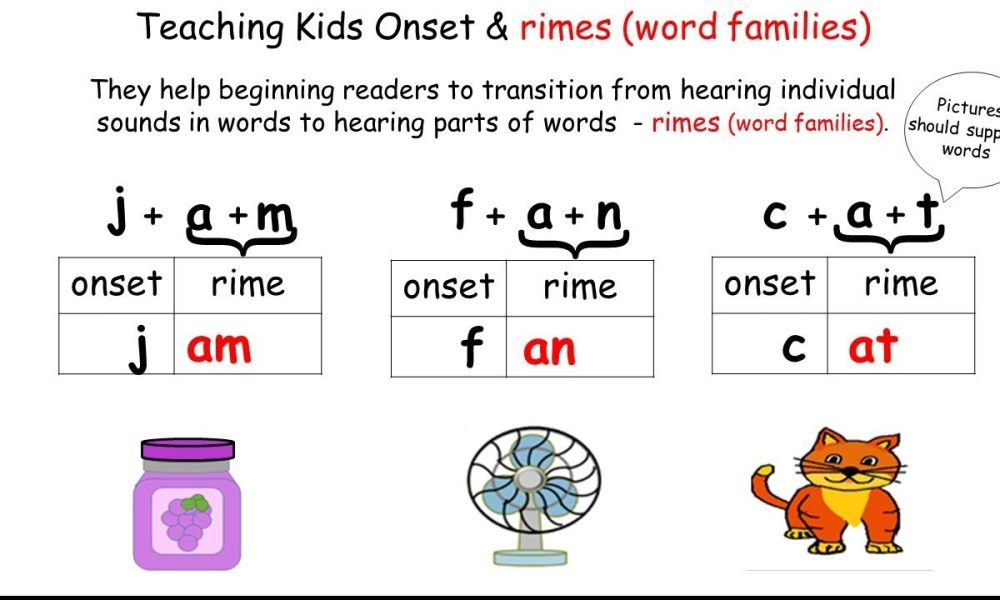
Understanding Onsets And Rimes: What Are Onsets And Rimes

Onsets and rimes make up the building blocks of phonological awareness. Simply put, onsets are the initial consonant sounds in a word, while rimes are the vowel and any consonants that follow. Understanding these components is crucial for early literacy development. By recognizing and manipulating onsets and rimes, children can start to decode and read words more effectively. Let’s delve deeper into what are onsets and rimes, and how they play a vital role in mastering language skills.

What Are Onsets and Rimes?
Welcome, young learners! Today, we are going to dive into the exciting world of onsets and rimes. Have you ever wondered how words are made up of smaller parts that help us read and write? Well, onsets and rimes are like the building blocks of words that make language learning a lot more fun and interesting. Let’s explore what onsets and rimes are and how they work together to help us become better readers and writers!
Understanding Onsets
First things first, let’s talk about onsets. An onset is the initial consonant sound or sounds in a word that come before the vowel. In simpler terms, the onset is like the beginning sound or sounds of a word. For example, in the word “sun,” the onset is the “s” sound at the beginning. Similarly, in the word “cat,” the onset is the “c” sound.
Onsets can be made up of one or more consonant sounds. They help us identify and pronounce words correctly. When we learn about onsets, we can break down words into smaller chunks, making it easier for us to read and write them.
Exploring Rimes
Now, let’s move on to rimes. A rime, also known as a phonogram, is the part of a word that includes the vowel sound and any consonant sounds that follow it. In simpler terms, the rime is like the ending of a word that comes after the onset. For example, in the word “cat,” the rime is the “at” sound.
Rimes help us recognize word patterns and families. When we learn about rimes, we notice that similar rimes appear in different words, creating word families. Understanding rimes can improve our reading and spelling skills by allowing us to make connections between words that share similar sounds and patterns.
How Onsets and Rimes Work Together
Now that we know what onsets and rimes are, let’s see how they work together in words. When we combine the onset and rime, we form a complete word. For example, when we put the onset “b” together with the rime “at,” we get the word “bat.” By understanding onsets and rimes, we can easily decode new words and expand our vocabulary.
Onsets and rimes play a crucial role in phonemic awareness, which is the ability to hear, identify, and manipulate individual sounds in words. By mastering onsets and rimes, we can improve our phonemic awareness skills, which are essential for successful reading and writing.
Practicing Onsets and Rimes
Now that we have learned about onsets and rimes, it’s time to practice! You can play fun word games, like rhyming activities and word building exercises, to strengthen your understanding of onsets and rimes. Try breaking down words into onsets and rimes to see how they fit together.
Remember, the more you practice, the better you will become at recognizing onsets and rimes in words. You can even challenge yourself to create your own silly words by mixing different onsets and rimes together. The possibilities are endless!
Benefits of Learning Onsets and Rimes
Learning about onsets and rimes has many benefits. It can help you become a more confident reader and writer by improving your decoding and spelling skills. Understanding onsets and rimes also enhances your vocabulary and comprehension abilities.
By mastering onsets and rimes, you will be able to break down unfamiliar words into smaller parts, making them easier to understand and remember. Additionally, onsets and rimes can boost your phonics skills, which are essential for becoming a proficient reader.
Congratulations, young learners, you have now unlocked the secrets of onsets and rimes! Remember, onsets are the beginning sounds of words, while rimes are the ending sounds. By understanding onsets and rimes, you can become a word detective, decoding new words with ease and confidence.
Keep practicing, exploring, and playing with onsets and rimes to continue improving your reading and writing skills. The more you engage with onsets and rimes, the more you will discover the joy of language and communication. Happy reading and writing!
Video 14: Onset & Rime (REL Southeast)
Frequently Asked Questions
What is an onset and rime in phonetics?
In phonetics, an onset refers to the initial consonant or consonant cluster of a syllable, while the rime is the vowel and any consonants that follow it within the syllable.
How do onsets and rimes work together in syllables?
Onsets and rimes work together to form syllables. The onset provides the initial sound or sounds of a syllable, followed by the rime which includes the vowel and any additional consonants that come after the vowel.
Why are onsets and rimes important in language development?
Onsets and rimes are important in language development as they help young children understand the structure of syllables and words. By recognizing onsets and rimes, children can improve their phonological awareness and later their reading and writing skills.
Final Thoughts
Understanding onsets and rimes is essential in developing early literacy skills. Onsets are the initial consonant or consonant cluster in a word, while rimes are the vowel and any following consonants. By breaking down words into these parts, children can better understand how sounds come together to form words. This knowledge helps with decoding unfamiliar words and improves overall reading fluency. Mastering onsets and rimes sets a strong foundation for phonemic awareness and reading success.